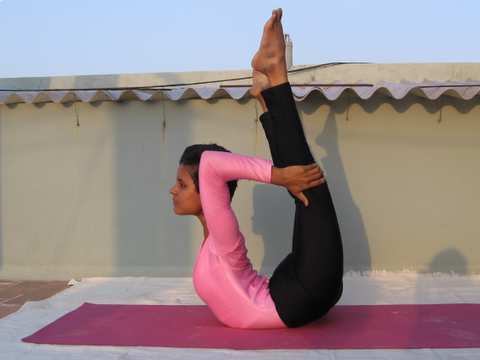
Quote of the day

Wednesday, May 4, 2011

Raja Kapotasana,The King Pigeon Pose

The name comes from the Sanskrit words kapota meaning "pigeon" and asana meaning "posture" or "seat".
The pigeon position can enhance physical health and mental awareness.It involves bending backward, a posture which helps to open up the chest and also strengthens the back and groin. It opens and increases the flexibility of the hips, at the same time strengthening the back, and stretching the thighs and the groin.
Raja-Kapotasana


Variations: 

 Kapotasana-Pigeon Pose:

Practicing the Pose:
Kapotasana:
1. Assume a sitting posture as in kneeling.
2. Support the body on the toes and the knees and gradually lean backward, after having fixed the arms from behind, the palms to the ground, the fingers pointing outward and the thumbs towards the toes.
3. Keeping the arms straight, slowly lift the pelvis while taking in the breath.
4. Next, press the body above the waist slowly both outward and upward, throwing the neck downward. 
5.Then place your forehead on the ground in between the toes.
6.Advanced yoga patus can try placing your chin to the ground.
7.Below image demonstrates the instructions
Kapotasana
 
Rajakapotasana-King Pigeon Pose:

Practicing the Pose:
Rajakapotasana:
1.Lie prone on the abdomen.
2.Bend the legs at the knee-joints from behind upward and fold them against their respective thigh.
3.With the arms to the front for support, at full length, bend knees well with the power. Then raise the neck simultaneously with a steady lift and pull upwards to the foot, while inhaling.
4.Then touch the middle of your head to the middle of your foots,balencing on your thigh muscle and keep breathing.
5.Below image demonstrates the instructions

Sukha Raja-Kapotasana

Eka Pada Rajakapotasana-One-Legged King Pigeon Pose:

Practicing the Pose:

Eka-Pada-Rajakapotasana:

1.Start on your hands and knees.
2.Bring your right knee forward so that the knee is bent at about a 30 degree angle, the right ankle is near the left wrist, and you are perched on your outer right buttock and hip. 
3.Square your hips and shoulders. 
4.Now stretch your left leg back. Use your right hand on the floor near your right hip for balance. 
5.Bend your left knee and catch your left foot with your left hand. Bring your left arm up near your left ear so that you must arch your torso into a backbend and keep your right hand showing the sky.
6.Lift your chest and breathe. Keep bringing your left hip forward to square your hips. On an exhale release and repeat on the left side.
This image can give you an idea on the instructions given:
Eka-Pada-Raja-Kapotasana
This is an Advanced in same position with touching your Fore-Head in to your Anklets with the support of both the hands.
Poorna-Eka-Pada-Raja-Kapotasana    


Variation in one leg pose

Salamba Kapotasana -Supported Pigeon Pose:

Practicing the Pose:
Salamba-Kapotasana:
1.Start on your hands and knees.
2.Bring your right knee forward so that the knee is bent at about a 30 degree angle, the right ankle is near the left wrist, and you are perched on your outer right buttock and hip. 
3.Square your hips and shoulders. 
4.Now stretch your left leg back. Use your right hand on the floor near your right hip for balance.
5.The image next to instruction can illustrate Salamba-Kapotasana.
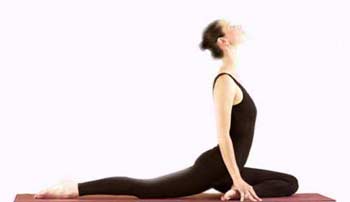
Salamba(supported)-Pigeon-Pose

Variation with Single Leg
Benefits:
1.Stretches, strengthens and tones spinal column.
2.strengthens and limbers hip joints and groin muscles.
3.stimulates metabolic and reproductive glands and organs.
4.increases vitality.

Chakrasana(Urdhva Dhanurasana),Wheel pose or Upward Bow Pose

The name comes from the Sanskrit words Chakra meaning "wheel",and Asana meaning "posture" or "seat".
Chakrasana is also sometime known as Urdhva Dhanurasana (Upward Bow Pose).

Iyengarji in Chakrasana position


There are two versions of chakrasana: the standing chakrasana (Wheel pose) and the supine chakrasana.

Chakrasana - The standing posture:


Chakrasana is a basic pose for beginners and is said to improve the elasticity of the spine and the flexibility of the hip joints. Yoga proponents say that the regular exercise of this asana makes the body resilient, the waist slim. It is also said to be helpful in removing the rigidity of the joints of the ribcage and increasing the capacity of lungs.


The Supine Chakrasana :
In the final poses of the supine chakrasana the posture resembles that of a wheel rim. This is an intermediate pose not recommended for beginners. It is said to be beneficial in exercising several parts of the body simultaneously in a short time. It exercises the neck, arms, wrists, fingers, spine, backside, thighs, knees, ankles and the feet. Strengthens the muscles and organs of the pelvic and abdominal area.

Practicing the Pose:
* Lie supine on the floor. Bend the knees and set the feet on the floor, heels as close to the sitting bones as possible.
* Bend the elbows and spread the palms on the floor beside the head, forearms relatively perpendicular to the floor, fingers pointing toward the shoulders.
* Pressing the inner feet actively into the floor, exhale and push the tailbone up toward the pubis, firming (but not hardening) the buttocks, and lift the buttocks off the floor.
* Keep the thighs and inner feet parallel. Take 2 or 3 breaths. Then firmly press the inner hands into the floor and the shoulder blades against the back and lift up onto the crown of the head.
* Keep the arms parallel. Take 2 or 3 breaths.
* Press the feet and hands into the floor, tailbone and shoulder blades against the back, and with an exhalation, lift the head off the floor and straighten the arms.
* Turn the upper thighs slightly inward and firm the outer thighs. Narrow the hip points and lengthen the tailbone toward the backs of the knees, lifting the pubis toward the navel.
* Turn the upper arms outward but keep the weight on the bases of the index fingers. Spread the shoulder blades across the back and let the head hang, or lift it slightly to look down at the floor.
* Stay in the pose anywhere from 5 to 10 seconds or more, breathing easily. Repeat anywhere from 3 to 10 times. 


Variations in Chakrasana:
Viparita Chakrasana Iyengarji
Eka-Pada-Chakrasana Iyengarji
Poorna-Eka-Pada-Chakrasana

Benefits:
1.The asana stretches the chest and lungs
2.The arms and wrists, legs, buttocks, abdomen, and spine gets strengthened.
3.Stimulates the thyroid and pituitary
4.Increases energy and counteracts depression
5.Therapeutic for asthma, back pain, infertility, and osteoporosis

Akarna Dhanurasana,Bow To The Ear Pose

"Holding the toes (alternately) with hands, pulling them (the toes) up to the (corresponding or opposite) ears, (and thus) assuming the shape of a stretched bow. This is called Akarna- Dhanurasana."
BKS Iyengarji in Akarna Dhanurasana

This pose is meant to mimic the shooting of a bow. Yoga practitioners attempt to identify patterns and perceptions that interfere with progression to an awareness of oneness. In old times these distractions were expressed as various demons and spirits or entities. This posture is performed as an expression of identifying these distractions and removing them.
Yoga Patu in Position
Steps in Practicing:

1. Bend the left leg in knee and keep the foot on the thigh of right leg. Keep the right leg straight.
2. Hold the big toe of the left leg with left hand, and that of the right leg with the right hand.
3. Exhale, and inhaling start lifting the left leg with the left hand and pull it up to the left ear, and stabilize it at that point.
4. Continue normal breathing.
5. After few seconds come back to the original position.
6. Then Repeat it with the left leg to the ear.

Variations in Akarna Dhanurasana:
There are few postures that stretch the big toes. It is important to have the big toes flexible. The usually turn inward and as a result vital energy currents do not run up the inner anterior leg. This affects almost every standing posture. Get the big toes flexible. There are many opportunities to grab them in other seated forward bends as well. 

Variation-1
Variation with Right leg
Variation with Left leg

Benefits:
1. It is a good posture to remove the pain of back and lumbar region.
2. It increases the elasticity of thigh joint and shoulder.
3. It is also useful in arthritis and rheumatic condition.

Tuesday, May 3, 2011

Dhanurasana,The Bow Pose(Urdva Chakrasana)

The name comes from the Sanskrit words Dhanura meaning "bow", and Asana  meaning "posture" or "seat".
Dhanurasana is also sometimes known as Urdva Chakrasana (Upward Wheel Pose).
Dhanurasana(Urdhva Chakrasana)

Dhanurasana is a yoga pose in which the practitioner lies on the belly, grasps the feet, and lifts the legs into the shape of a bow.Dhanurasana, or the bow curve pose, is a cultural asana that has a beneficial effect on several muscles in the body, including those of the back, the forearms and the abdomen.

Practicing:
Position-1

Position-2
A sequential process for performing Dhanurasana follows.
* Lie prone on the abdomen.
* Bend the legs at the knee-joints from behind upward and fold them against their respective thigh.
* With the arms to the back, at full length, grasp the ankles well with the hands. Then raise the neck simultaneously with a steady lift and pull upwards on the ankles, while inhaling.
* Next, rest the entire body on only the area of the navel (umbilical region), assuming a somewhat circular position. In order to derive the highest benefit from this pose, the knees should be kept together. This pose has to be maintained as long as it is comfortable with retention of breath.
* Then release the hold on the ankles, begin to exhale and assume the starting position-prone on the abdomen, the legs fully stretched out and the arms rested on the floor. It is best to pause before another round.
* The practitioner may either repeat the pose of Dhanurasana eight times in two minutes or maintain the pose for the duration. The latter posture is preferable only after a few months of practice.
BKS Iyengar in Dhanurasana

Poorna Dhanurasana
Benefits:
*The hygienic features of this posture are the extraordinary amount of pressure, due to the whole body being thrown upon the umbilical region only; the extreme stretching of the abdominal and pelvic muscles; and the steady pull anterior pull throughout the spinal column, with the alternate contraction and relaxation of the spinal muscles.
*Further, the venous drainage facilitates fresh supply of blood to the abdominal viscera, especially of the lower abdomen and the reproductory organs.
*Several muscles, including the extensors of the hip, elbow, wrist and drunk, and the abdubtors of the shoulder joints are exercised by this asana.
*The quadriceps and pectorals are also strained thanks to holding the legs in the bow curve position.

Girl in Poorna Dhanurasana


Adho Mukkha Svanasana,The Downward-Facing Dog

The name comes from the Sanskrit words adhas  meaning "down", mukha meaning "face", svana or shvana  meaning "dog", and asana  meaning "posture" or "seat".

The preparatory position is with the hands and knees on the floor, hands under the shoulders, fingers spread wide, knees under the hips and typically about seven inches (17 cm) apart, with the spine straightened and relaxed.
On a deep exhale, the hips are pushed toward the ceiling, the body forming an inverted V-shape, with an arch in the back. The legs and arms are straight, the elbows engaged, the shoulders wide and relaxed. The heels move toward the floor. The hands and feet remain hip-width apart. If the hamstrings are very strong or tight, the knees are bent to allow the spine to lengthen fully.
Stress on the wrists is reduced by pressing down with the fingers and borders of the palms, and pushing the hips up and backwards. The head drops slightly. The heart moves toward the back.
The hips move up and back. Focus is on the breath while holding the posture, with deep, steady inhalation and exhalation creating a flow of energy through the body. On an exhale, the practitioner releases onto the hands and knees and rests.
 Benefits:
BKS Iyengar throughout the body, particularly the arms, legs, and feet; relieves asserts that this posture stretches the shoulders, legs, spine and whole body; builds strength fatigue and rejuvenates the body; improves the immune system, digestion and blood flow to the sinuses, and calms the mind and lifts the spirits.

Sunday, May 1, 2011

Viparita Karani,the Inverted Pose-variations in Sarvangasana

In Sanskrit, `Viparita` means inverted and `Karani` means an action, and the asana derives its name from the posture that involves inverting the position of the body, placing the head at the bottom and the legs on top.


Viparita Karani, or Inverted Action Pose, is an intermediate yoga asana, in which the practitioner lies down on a mat and lifts the legs perpendicular to the ground. Yoga practitioners consider it as a pose that improves pelvic circulation and increases the blood flow to face, neck and thorax and improves the functioning of adrenal, pituitary and thyroid glands. It is also referred to as legs-up-the-wall pose.

How to position the pose:
  • Practitioner has to sleep straight on mat,with hands stretched above neck.
  • Next step,lift up your leg 30 degree from ground level,then 60 and finally 90 degree this will test ur capacity and strengthens your abdominal.
  • Place both of your hands straight and hard support weight with fre arms.
  • The weight of the body is, thus, raised and supported by stiffening the arms that are still stretching along the ground.  
  • Then lift your hip up and support your hip-bone with both the hands and keep leg straight. 
  • Here the trunk does not make a right angle with the ground as in Sarvangasana, but simply takes an upward curve. 
  • The chest does not press against the chin, but keeps itself away from the chin. 
  • The eyes are either closed to concentrate the mind upon a particular part in the body or are kept fixed upon the toes.
 Youngsters can do anything but what about the people aged and who struggle even to raise a single leg up in air so for aged poeple or whom wants to learn without strain try this technic.
Raise your arms straight and keep breathing deeply.

Note:Keep in mind that you are doing yogasana not any other simple exercise.So,keep breathing as long as you can,if you held your breath while in action then the respected muscle will get strain or sometimes it may effect adversly.
Another main thing to keep in mind while lifting your legs do not forget to breath,in yogasana positions may be like anything but while lifting any parts of your body you must and while leaving down exhale.

Halasana,Plough pose-Variations in Sarvangasana

The name comes from the Sanskrit words hala meaning "plow" and asana meaning "posture" or "seat".

Halasana is a cultural asana deriving its name from Hala, meaning `plough` in Sanskrit, and alleivates the symptoms of backacke, headache, insomnia and sinusitis.

This pose can put significant strain on the cervical spine, which does not normally undergo this type of stress, and can cause injury if not performed properly.
As alternatives, simply lying on the back and raising the legs into a hamstring stretch, or doing a seated forward bend may be appropriate.


Positions:


Benefits :
* If there is a complaint of Dyspepsia or constipation, it can be corrected by the practice of this Asana.
* The practice of this Asana is also useful in certain types of diabetes.
* Calms the brain.
* Stimulates the abdominal organs and the thyroid gland.
* Stretches the shoulders and spine.
* Helps relieve the symptoms of menopause.
* Reduces stress and fatigue.
* Therapeutic for backache, headache, infertility, insomnia, sinusitis.
* Since the spine is stretched fully in a curve, it becomes more elastic and its overall functioning is improved.
* All the muscles from toes to waist are also stretched helping improvement in the functioning of veins.
* This asana is also useful for gastric troubles, digestion problems.